
For more than a decade, we’ve been asking the same question: what’s the difference between a Product Owner and a Product Manager?
And yet here we are. Companies still can’t see the value of product. Product Owners quietly become project managers. Talented people get dropped into roles with no training and no clear expectations, then get blamed when it doesn’t work.
I’ve lived on both sides of this. I started my career as a business analyst, became a Scrum Master, then landed my first Product Owner role before moving into product management. I lived and breathed Scrum before I ever stepped into the wider product world. So this one is personal.
Let’s start with where it all came from, because the history explains more than you might think.
🧭 Two roles, two origin stories
The Product Manager isn’t new. The role can be traced back to the mid 20th century, when businesses realised they needed someone to oversee a product’s entire life, from idea to launch to ongoing management. In the 1950s and 60s, this showed up as brand management in consumer goods companies.
As technology companies grew through the 70s and 80s, the role followed them into software. Then the internet arrived, markets started moving faster, and Product Managers became the people responsible for understanding customer needs, shaping strategy and steering a product through constant change. Today the role is about the whole picture: vision, customers, market and business outcomes.
The Product Owner came from somewhere else entirely.
When Jeff Sutherland and Ken Schwaber introduced Scrum in the early 90s, there was no Product Owner at all. As agile thinking matured, people recognised the need for someone inside the team to represent the customer and the business. The role was formally defined in the 2007 Scrum Guide, focused on managing the backlog and making sure developers delivered value incrementally, sprint by sprint.
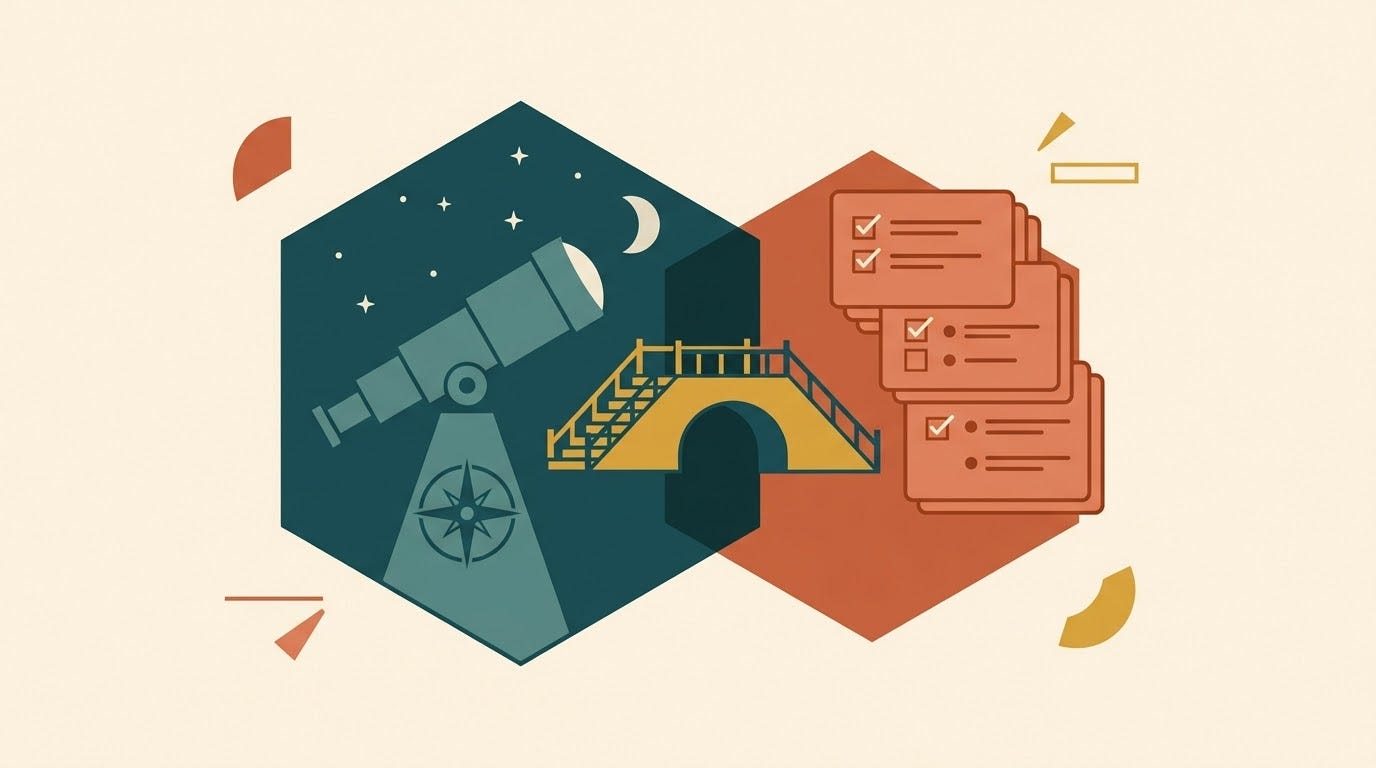
So one role grew out of decades of managing products end to end. The other was created to bridge the gap between business and developers inside a software framework.
Different roots. Different purposes. And that’s where the trouble starts.
⚠️ Why the confusion keeps happening
Here’s the thing. It has nothing to do with the title. Both roles can complement each other beautifully. The problems come from three places.
1️⃣ Vision versus execution
Product Managers typically own the long term strategy and vision. Product Owners have traditionally focused on the day to day: refining stories, working with developers and keeping delivery moving.
When an organisation only has the tactical half, teams feel it. Tech leads constantly ask where the product is heading, and for good reason. They need that lens to decide which technical foundations to build now so the platform can scale and evolve later. Without it, technical debt piles up, pivots become painful, and honestly, it’s just demotivating to build without knowing where you’re going.
2️⃣ Stakeholders versus customers
Product Managers spend time with customers, market data and business experts to understand where things are heading. Product Owners have often worked mostly within their team and with internal stakeholders, deciding what the business wants to build next.
The problem appears when what customers need clashes with what the business has asked for. Stakeholders usually know how something should work. They don’t always see the customer experience or the real problem underneath. If no one is bridging that gap, you risk solving the wrong problem beautifully, and the product, and eventually the business, pays for it.
3️⃣ No one is coaching product
When agile spread across organisations of every size, the Agile Coach role emerged to guide teams through massive change in mindset, structure and ways of working. It’s a huge, complex job, and I genuinely appreciate the value Agile Coaches bring.
But they’ve also become the default coaches for Product Owners. That coaching usually covers writing user stories, prioritising, working with developers and managing stakeholders. I took my Certified Scrum Product Owner course many years ago and it helped me grow beyond my BA skillset. I also completed my Certified Scrum Master training, which went incredibly deep into running high performing teams.
That’s exactly the point. Agile Coaches go deep on Scrum Masters and delivery. Deep product craft like customer interviews, strategy, vision and market validation was never their brief, just as they aren’t there to teach engineers how to code or designers how to design.
Without specialised product coaching, engineers, designers and testers end up working with one product person who thinks strategically, then another who is purely tactical. No wonder they start questioning what the role is even for.
🌱 So how do we move forward?
In the full video, I go deeper into three practical shifts.
✅ Get clear on roles
Define who owns strategy and who owns execution, and make sure everyone understands it. One approach I’ve seen work well: Product Owners run the backlog and daily delivery, while Product Managers hold the long term vision and connect the work to business goals. Even better, have Product Owners report into Product Managers, so the PO role becomes a genuine step on a product career path rather than a side job reporting into a business function.
✅ Coach your leaders
More and more business leaders are taking accountability for product functions, or stepping into the Product Owner role themselves. If that’s you, work with a product coach. Product shapes both strategy and execution, so you need to know exactly what you’ve signed up for. A good coach also accelerates learning for you and your team with real examples, and helps you adapt as markets, technology and customers shift.
✅ Connect Agile and product coaches
This is the one I feel most strongly about. Agile and product ultimately want the same thing: real value for customers, delivered incrementally, with real returns for the business. Yet I rarely see Agile Coaches and product coaches talking to each other.
Imagine if they did. Agile practices would align with product strategy. Teams would share one understanding of priorities. Agile coaches could share the mindset and principles, while product coaches brought the vision and customer lens. The result is a balanced focus on both how we build and what we build.
The title was never the problem. The lack of clarity is.
Watch the full video
I walk through the full history, what I learned moving between both roles, and how to put each of these shifts into practice in your own organisation.
I’d love to hear from you. Which role are you in, and does your organisation actually know the difference?
Ready to bring more clarity to your product career or team? Let's chat. Book a call with me.